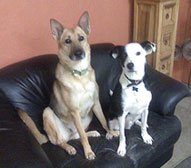




Your dog is perfect at home. They sit, stay, come when called, walk nicely on a leash in your quiet neighborhood. You've put in the work. You've practiced. Your dog knows what to do.
Then you take them to the park, the vet's office, or your friend's house — and it's like they've never been trained at all. They pull on the leash, ignore your commands, jump on people, and act like a completely different dog.
What happened?
- Did your dog forget everything you taught them?
- Are they being defiant?
- Did the training fail?
None of the above. Your dog hasn't forgotten anything, and the training didn't fail. What's happening is that your dog's ability to respond to training depends heavily on their mental state — and new or exciting environments dramatically change that state.
Why Dogs Behave Differently in Different Places
Dogs learn in context. When you train your dog at home, they're learning to sit, stay, and come when called at home. That specific environment — the familiar smells, sounds, sights, and low-stress atmosphere — becomes part of the training.
When you move to a new environment, everything changes. New smells overwhelm their senses. Unfamiliar sounds trigger alertness. Other dogs, people, or animals demand attention. The mental space your dog needs to focus on your commands gets crowded out by the mental work of processing all this new information.
It's not your dog "choosing" to ignore you. It's genuine cognitive overload. Your dog's brain is so busy processing the environment that there's not enough mental bandwidth left for obedience, and since your dog didn’t learn the behavior in this setting, they do not have the context to go back to it.
The Difference Between Knowing and Doing
Your dog knows the commands. If you brought them back home right now, they'd perform perfectly. The knowledge is there. What's missing in the new environment isn't knowledge — it's focus.
Think of it this way. You know how to do complex math. But if someone asked you to solve a calculus problem while you're riding a roller coaster, you probably couldn't do it. Not because you forgot calculus, but because your brain is too busy dealing with the roller coaster to focus on math.
That's what new or exciting environments do to your dog. The environment itself is the roller coaster. The commands you're giving are the math problem. Your dog's brain simply can't do both at once.
Why Some Environments Are Harder Than Others
Not all environments create the same level of distraction. Your dog might do fine at a quiet park but fall apart at a busy one. They might listen at your friend's house but ignore you at the vet.
The level of distraction depends on several factors. Novel environments — places your dog has never been — are more distracting than familiar ones. High-stimulus environments with lots of dogs, people, noises, or movement are more challenging than calm, quiet places.
Environments that trigger fear or anxiety are particularly difficult. A dog that's nervous at the vet isn't ignoring your commands out of defiance. They're in a heightened emotional state that makes focus nearly impossible.
Exciting environments can be just as challenging as scary ones. A dog park full of other dogs is so stimulating that your dog's excitement overwhelms their ability to respond to you.
The Training Gap Most People Don't Know About
Context is also so important. Most dog owners train at home and then expect their dog to perform everywhere else. But training in one environment doesn't automatically transfer to other environments. You have to teach your dog to listen in distracting places by actually training in those places.
This is where many dog training programs fall short. They focus on getting the behavior right in a controlled environment, then assume the dog will generalize that training to the real world. Some dogs can. Many can't.
The ForceFree Method addresses this by teaching dogs to focus on their handler regardless of what's happening around them. It's not about drilling commands harder. It's about building the dog's ability to tune into you even when there are distractions.
Building Reliability in Distracting Environments
Getting your dog to listen everywhere takes a progression. You can't skip from a quiet living room to a crowded dog park and expect success.
- Start Where Your Dog Can Succeed — Begin in your home where your dog already knows the commands. Make sure they're responding reliably before you add any difficulty.
- Add Small Distractions Gradually — Move to your backyard. Then a quiet street. Then a slightly busier area. Each time, you're asking your dog to respond to commands in a slightly more distracting environment. Don't jump to high-distraction areas until your dog is succeeding at moderate ones.
- Practice in Specific Locations — If you need your dog to behave at the vet, practice near the vet's office (not during an appointment). If you need them to listen at your friend's house, practice there when it's calm. Train in the actual places where you need reliability.
- Keep Training Sessions Short in New Places — Your dog's focus will fatigue quickly in distracting environments. Five minutes of good focus is better than twenty minutes of your dog tuning you out. End on success.
- Reward Focus, Not Just Commands — When your dog looks at you in a distracting environment, that's huge. Reward that. The ability to check in with you when there are other interesting things happening is more valuable than perfectly executed sits and stays.
Private training lessons let you work with a trainer in the specific environments where your dog struggles. A skilled trainer can show you how to set your dog up for success and how to recognize when you're asking for more than your dog can handle in that moment.
The key is working with a trainer who understands that getting dogs to respond in distracting environments requires more than just repetition. It requires building the dog's focus and teaching them that you're more interesting than whatever else is happening.
Boarding school programs can also work well for building environmental reliability because professional trainers can expose your dog to a wide range of environments and distractions in a controlled way. Your dog learns to respond to commands in many different contexts, which builds genuine reliability rather than context-dependent obedience.
Common Mistakes That Make It Worse
Dogs are not humans, which also means that sometimes our reaction to a behavior can actually make it harder, not easier, for the dog. For example, these common mistakes can make the problem worse.
- Repeating Commands — When your dog doesn't respond in a distracting environment, repeating the command over and over teaches them that commands are optional. Give the command once, then help your dog succeed (by reducing the distraction or moving them away from it).
- Getting Frustrated — Your frustration adds to the chaos your dog is already experiencing. It doesn't help them focus. It makes focusing harder.
- Testing Instead of Training — Going to a busy park to "see if your dog will listen" isn't training. It's testing. If your dog fails, you haven't learned anything useful, and your dog has just practiced ignoring you. Training means setting your dog up to succeed, not testing them in situations where failure is likely.
- Skipping Steps — You can't go from a quiet living room to a dog park and expect success. The progression matters.
Mistakes with dogs can also be more problematic than mistakes with people. People learn and know forever. Dogs can “unlearn” if the context around them and the training changes.
Managing Real Life While You Train
You still have to live your life while you're working on this. You can't avoid all distracting environments until your dog is perfectly trained.
Use management tools when you need reliability in situations your dog isn't ready for yet. A leash prevents your dog from running away even if they don't come when called. Physical guidance (like gently guiding your dog into a sit) helps them succeed when they can't focus enough to respond to a verbal command.
Don't think of this as failure. It's just reality. Your dog is learning. Until they're reliable, you use tools and management to keep them safe and set them up for success.
Why This Takes Time
Building reliability in distracting environments takes longer than most people expect. You're not just teaching commands. You're teaching focus. You're building your dog's ability to tune into you when their instincts are screaming at them to pay attention to something else.
This is hard for dogs. It goes against their nature. Dogs are designed to be alert to their environment. Teaching them to focus on you instead of that squirrel/dog/person requires rewiring their priorities.
Be patient. Celebrate small wins. The first time your dog looks at you at the dog park instead of running off to play, that's huge progress. The first time they sit at the vet's office, even if it takes three tries, that's success.
Getting the Help You Need
If your dog is perfect at home but ignores you everywhere else, you're not alone. This is one of the most common challenges dog owners face.
At Chicago Dog Trainer, we specialize in building reliable off-leash responsiveness even in highly distracting environments. Our Pack Leader Program focuses on teaching your dog to focus on you regardless of what's happening around them.
We also offer remote dog training via Zoom for those outside the Chicago area, helping you work through these challenges wherever you are.
The ForceFree Method works because it builds genuine responsiveness based on your dog's natural desire to cooperate with their pack leader. When you establish that relationship and teach your dog that you're more interesting than distractions, you get reliability everywhere — not just at home.
Contact us at 224-407-2131 to learn how we can help you build the off-leash reliability you're looking for. Your dog can learn to listen everywhere. They just need the right training approach.